RRAM (Resistive Random Access Memory) can be considered a type of memristor. In this article, we will explore this device, which is one of the next-generation semiconductors.
Memristor Description
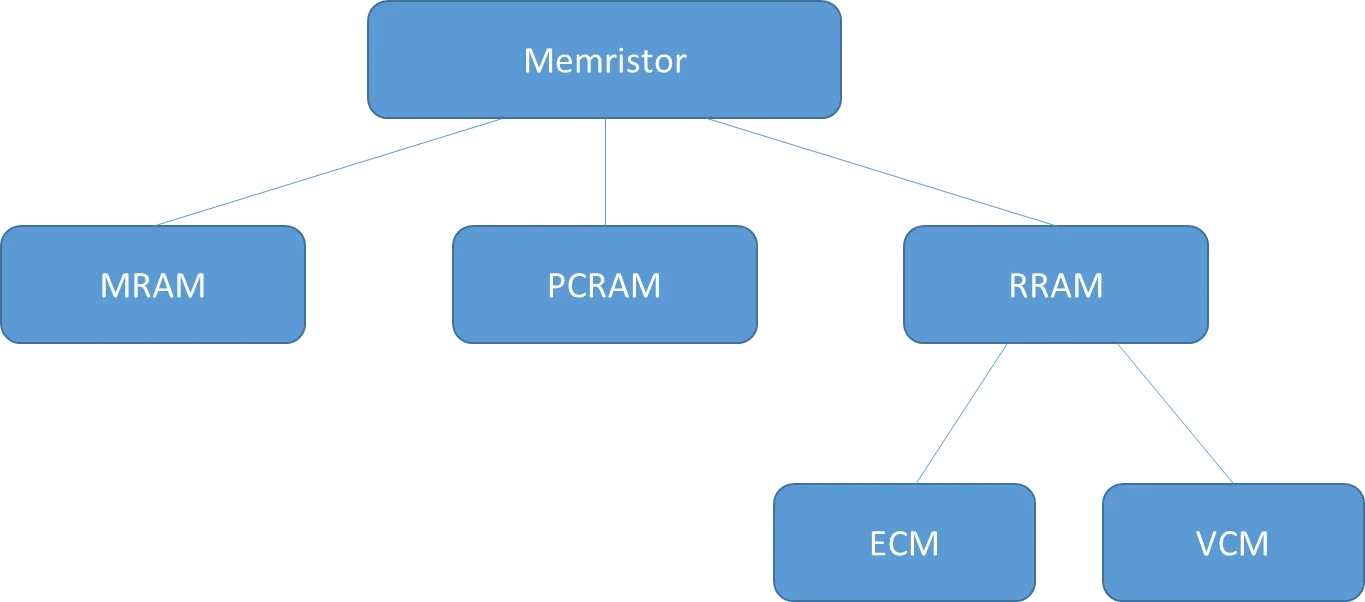
A portmanteau of "memory" and "resistor," it refers to a device capable of storing resistance values. With its fast data processing speed, high power efficiency, and high integration, it can be used in neuromorphic computing, overcoming the limitations of the existing von-Neumann architecture. Therefore, it is being researched as a next-generation memory.

Among them, the RRAM I studied during my master's program can be classified into ECM (Electrochemical Metallization Mechanism) and VCM (Valence Change Mechanism). ECM switches by forming a metal filament (mainly using Ag or Cu) as the metal used in the electrode penetrates into the insulator layer inside the device due to electrical stimulation, whereas VCM switches by having oxygen vacancies (Vo) in the oxide used as the insulator act as a filament (Conductive Filament, CF).
Since I researched VCM, specifically HfOx-based RRAM, I will explain based on VCM.
Operating Mechanism
This device is composed of a simple structure of MIM (Metal – Insulator – Metal). The basic structure is TE (Top electrode) – Switching layer – BE (Bottom electrode). The Switching layer is a layer that affects the resistance of the device through the process of forming or disappearing filaments inside, and HfOx TiOx TaOx are often used.
Typically, TE and BE use a metal that reacts poorly with oxygen (e.g., Pt) on one side and a metal that reacts readily with oxygen (e.g., Ti, Ta) on the other. Alternatively, an oxygen reservoir layer is used, which forms Vo inside the switching layer to create a filament and determine the switching direction.

Forming process
Naturally, the initial state is the high resistance state (HRS). Here, when a strong voltage (- in the figure above) is applied to the top electrode (TE), breakdown occurs within the switching layer, and oxygen ions move, generating a large number of Vo in the switching layer. This forms a filament, changing to the low resistance state (LRS).
Reset process
When a voltage (+) opposite to the forming voltage is applied, the oxygen ions that exited the switching layer move back into the switching layer. This causes the filament to break and the HRS state to occur. This is called the reset process.
Set process
When a negative voltage (-) in the same direction as the forming voltage is applied to the reset device, oxygen ions in the switching layer are released, reforming the filament. Generally, the set voltage is lower than the forming voltage.
When operating a device, the polarity of the voltage varies depending on the device structure. That is, the Forming voltage and Set voltage for a device whose structure is reversed (as shown in the figure above) must be positive. What's important is the direction of oxygen ion movement, which depends on the device structure.
Then, in the next article, I will explain how to check the characteristics of this device.
References: https://ietresearch.onlinelibrary.wiley.com/doi/10.1049/iet-cds.2018.5388


